Let me preface this review by saying that I believe academic scholarship should always be written with a priority for accessibility: the language should be evocative and immersive, perhaps even bordering on fiction, without sacrificing nuance and academic details. Histories in particular are tasked with chronological transport; it is my belief that they should do this without requiring a maximal effort on the part of the reader.
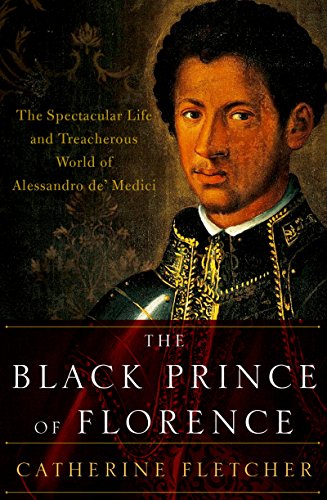
Fletcher’s The Black Prince does all this, and with an ease that belies the hard work of writing. The Black Prince sends the reader back in time so effortlessly; the reader can feel the tension of the Florentine court, the potential for danger at every meal (poison) and around every corner (gangs of rich young men armed with daggers and arrogant tempers).
The Black Prince is academic writing for a general audience done right.
The Black Prince ostensibly revolves around Alessandro de’ Medici, the half African, half Florentine illegitimate son of a Medici scion (though which one is a matter of debate in this work); however, it also about much more than that. This history offers the reader a velvet texture of Renaissance Europe through vivid accounts of the intricate Habsburg, Vatican, French, and Florentine connections via marriage, money, and ambition.
That said, race is less of a category of analysis here than is class, religion, or aristocratic birth. This is no shade on Fletcher’s work; The Black Prince makes the profound point that race — as we understand it — was not an analogous factor in this period of time, in this Renaissance world. Indeed, it was class, religion, aristocratic birth, wealth, and connections which were the more influential factors in matrices of power. “Race” did exist, but functioned and featured in aristocratic society very differently than it would a hundred, two hundred, three hundred years later.
Fletcher does take us through the span of Alessandro’s life; the book is bookended by his birth and death and includes all the major events of his life and that of his domain, Florence, in his lifetime; but this is a work about the Renaissance and the politics of the Apennine peninsula in this period.
Butcher’s Work: True Crime Tales of American Murder and Madness by Harold Schechter
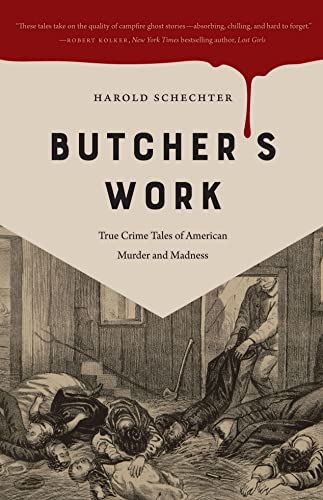
The premise of Schechter’s Butcher’s Work is intriguing enough to entice any fan of true crime to pick it up: Serial killers and murder are nothing new, why have we forgotten some crimes and remembered others? And, more curiously, what are those cases which we have forgotten? The easy answer is that they weren’t horrendous enough, disgusting enough, criminal enough to earn a place in our long, collective memory. But the cases in Butcher’s Work dismisses that possibility quickly; the crimes highlighted in this work are all that and more chilling. The fact that they have disappeared from our remembrance is itself quite a horrific notion.
Butcher’s Work is divided into four sections: Butcher’s Work, The Poison Fiend, Lady-Killer, and The Ragged Stranger. As their titles suggest, each one focuses on a particular method or victim of murder. There is a featured case of each, but interspersed within the pages of the chapters are cameos of other criminals employing the same method. Collectively they form a creepy landscape of crime, where trusting another human being is something to fear. Lady-Killer was one of my favorite sections. Marriage and murder form the central focus here, a gendered violence perpetrated by men against women. I won’t spoil it for anyone, but DANG, how did these men get away with this? Oh, right, but still!
Schechter is a marvelous story-teller. The prose flows, as compellingly as the stories and characters. And, as a researcher myself, I deeply appreciate the depth and details Schechter has excavated in this work. The result is not only a focused, historically rich, and keen archival piece of work; Butcher’s Work is also a nuanced landscape of American life in the 19th century. Schechter brings to the reader’s attention how it is not only the ambition of the criminal, but also the systems and structures of society that permit and foster these crimes. How else might a man such as Hoch in Lady Killer commit bigamy and murder so successfully and remain for so long undetected? What gave him the confidence to believe in his own acquittal? Of course, the criminals here were apprehended, so there is a more optimistic ending. We can rest knowing the authorities — police, witnesses, lawyers, courts, etc — did succeed in forcing them to confront their crimes. But, I could not help but wonder how many others got away with it altogether? The idea is spine-chilling.
Butcher’s Work is a fantastic read for any fan of true crime and 19th century American history.
Black Tudors: The Untold Story by Miranda Kaufmann
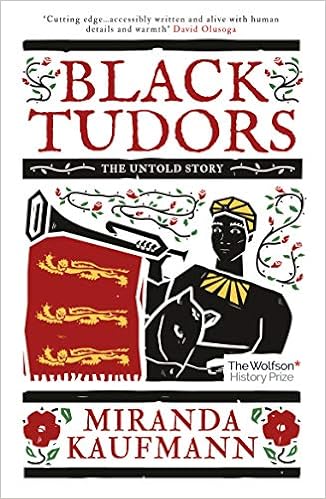
This is the kind of history and historical writing that excites me! Kaufmann’s Black Tudors is a gem because of its topical focus, that is, centering black history, its accessible language, and smooth, flowing prose. I was very excited to read this book and it exceeded expectations!
Black Tudors is split into ten content chapters, bookended with an introduction and conclusion. Each chapter focuses on a specific individual, a black person who left a mark — sometimes a small one — in the historical record for us to find. These individuals were not lords or aristocrats (like Alessandro de Medici, Duke of Florence), but ordinary working folks who came to England through a number of avenues: trade, servitude, attached to diplomatic entourages, etc. While each chapter focuses largely on the individual who lends the chapter their name for its title, Kaufmann also includes evidence of other Black individuals from North and West Africa, the Southern Mediterranean, the Middle East. The result is a rich historical landscape of a hidden minority community and the cultural, social, and political context of their Tudor world.
The reader gets a textured, almost tactile experience of Tudor life, not from an aristocratic or royal perch, but from below. Kaufmann grants the reader entry into the working, merchant classes, into the world of the laborer, the Tudor servant class. This is a culture without a “middle class” in the way in which we understand the term, but there is a servant class, a working class, a peasant class, a mercantile class. Kaufmann gives us a view of these worlds from within and through the lens of foreigners, Africans, and Muslims.
Kaufmann adds to a growing number of histories which add color to the whiteness of European history. It joins the work of Marc Matera, Olivette Otele, and others which have and continue to excavate blackness in a traditionally white-centric history. That said, this is hard work; the act of research in these kinds of histories is difficult as so many layers need to be peeled off to discover hidden individuals in the historical record. I fully acknowledge Kaufmann’s effort and applaud their thorough research.
As an example of historical method and empiricism, Black Tudors shows the reader how to weave a history and a prosopography from very little archival material. This makes this book an excellent historiographical case study for an under– or graduate level seminar on historical methodology.
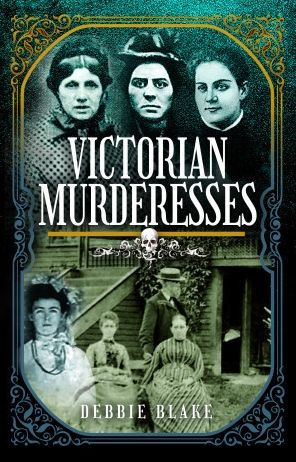
I am sucker for a good true crime non-fiction, any time — and Blake’s Victorian Murderesses absolutely satisfied my every expectation of the genre. It was gory and chilling, all the more so because of the historical grounding of each case covered here.
Each chapter — there are seven of them — examines a specific killer and the details of her crime(s). Four of them focus on British murderesses: Sarah Drake, Mary Ann Brogh, Kate Webster, and Mary Ann Cotton, while the remaining three cross the Atlantic to provide accounts of the disturbing murders perpetrated by Kate Bender, Lizzie Borden (of course), and Jane Toppan. I was grateful that Lizzie got only a chapter; the fame of her crime has sullied my interest in her case. I’ve simply read it too many times for it to invoke any novel shock, but I acknowledge that the Borden murders warrant a place in a book like this.
What makes Victorian Murderesses such a fantastic read is the way in which Blake colors in the context of these women’s lives; not only do we get a rare glimpse into their worlds, but the Victorian world as a whole, especially as it was for women of a certain working and middle class. The reader also gets to see how these women got away with their crimes for a significant part of their lives and how police operated to discover them. In some cases, like with Sarah Drake, I could not help but feel a bit sorry for the murderess as much as the victims; institutionalized sexism drove some of these women to extreme lengths — though I cannot say I condone their decisions to take innocent lives. In some cases, like Cotton’s and Webster’s I found myself wondering how it was possible for them to commit so many crimes without getting caught earlier! I wonder at how it was that Lizzie Borden became so famous when these other women committed so many more criminal acts.
Kate Bender and the Bender family were — for me — the most dastardly, the creepiest of the seven chapters. Their crimes were like those out of a grisly, B-rated horror where a family of four drives down a lonely farm road… and is never seen again… Brr. I feel shivers thinking of it now.
This was a fantastic true crime read, fun and gore all around, enough to keep you wanting more.
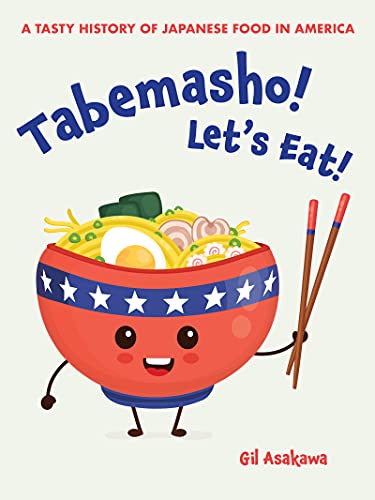
Tabemasho! Let’s Eat! A Tasty History of Japanese Food in America by Gil Asakawa
Tabemasho! Let’s Eat! reminds me of one of the very first times I went out to eat in America. I’d been in the country for a few days, maybe a week, and I was taken out to dinner at a local Chinese American restaurant. I was thrilled, having never had Chinese American food before. At the end of the meal my hosts asked me, “What kind of fortune cookies do y’all have over there?” I was stunned. “We don’t have them in Asia.” Then they were shocked, having always assumed that fortune cookies were authentic desserts from the exotic East. The culture shock on both sides of that encounter and the histories behind the assumptions made around food are what Asakawa’s Tabemasho! Let’s Eat! brings to the forefront.
Though there is a serious side to Asakawa’s Tabemasho! Let’s Eat!, the book is a fun, fun read. Asakawa’s prose is super-casczz, chummy, and hilarious. Reading him is like having a beer with a friend who’s found a great place to eat and can’t wait to take you there. Asakawa was quick at the elbow with a witty comment. He was there to give me the low-down tale behind a (his)story.
I appreciated was the book’s serious side too. I enjoyed how unafraid Asakawa was to speak his mind on the tougher topics of cultural appropriation and America’s racist history of Asian exclusion. Indeed, much of Asakawa’s point is that Japanese American cuisine and culture is borne out of that dark period.
The book is split into thematic chapters, each one taking on a different dish like Noodles or Bowls of Rice (don), or Sushi. Asakawa also devotes a chapter to Japanese American history and the ways in which transcultural cuisine develops through migration, separation, and racism. The sushi and noodle chapters are especially extensive, providing the reader with tips on where to go and what to expect, types of dishes, the differences between Japanese and American interpretations of various dishes, as well as histories of these dishes from both sides of the Pacific Ocean.
There are also chapters on lesser known delectables such as Japanese soft drinks. I was so happy to read about PocariSweat — one of my childhood favorites, sold in Southeast Asia by the case! — which is (I think), the inspiration for one of my favorite fizzy drinks, 100 Plus. I can’t describe how they taste; they’re a cross of salty and sweetness, their appeal much like chocolate-covered pretzels. I grew up in South Korea for a time as well; it was there I became familiar with Yakult, Calpico and the whole plethora of yogurt-based drinks that are so popular in East Asian culture. Reading these chapters was like sipping at a memory of my childhood.
The chapter on baked desserts and pastries made my mouth water. Stopping at a Chinese, Korean, or Japanese bakery is one my favorite weekend excursions. The soft, sweet, white bread that melts in your mouth is a paradise. The red bean pastes, creams, and the custards are unique interpretations of Chinese, French, and European treats.
Asakawa also provides the reader with an extensive (though non-academic) bibliography and reference list so the reader can let themselves wander further on this culinary path.
Black Victorians: Hidden in History by Keshia N. Abraham & John Woolf
First, let me begin this review by stating: I WANT A COPY OF THIS BOOK. Please, Somebody, get me this for Whatever-the-Next-Gifting-Holiday-is! I also fervently hope that Duckworth Books will have this available (at a reasonable price!) through an American imprint so it can be adopted for college courses in the United States. This is the perfect book for a decolonizing history curriculum whether the course is focused on Modern Europe, Black History, History of Racism, Modern World — or, in my case — Roots of Contemporary Issues.
The reasons: First, the book is broken down into assignable, digestible thematic sections and chapters which focus on a single individual and their historical significance. Part One is “Context and Concealment” and it provides an overview of the state of black history in Europe and in Victorian Era historiography. Here, the point is made that the act of existing is resistance itself, it is a decolonizing act to just be. Bringing these histories to the forefront is a necessary and powerful step towards decolonizing history as it is popularly understood, historical narrative, and the academy. The following sections: “Struggle and Survival”, “Church and State”, “Cultural VIPs”, and “Fighting for Freedom” offer well-researched deep dives into specific individuals across all classes, genders, and social positions. Working class black Britons, criminals, socialites, intellectuals, clergy, activists and freedom fighters are given a moment of spotlight and discussed as part of a larger colored and white fabric of Victorian society. This is a fantastic prosopography. And it could easily be partitioned to assign one or a few chapters per week to undergraduate students.
The second reason this book is ideal for an undergraduate seminar or an introductory survey course is because the readability of this book is amazing. Abraham’s and Woolf’s prose is smooth, the language requires little effort, their arguments are explicit, allowing for an easy transition from archival data to analysis to discussion. Indeed, the shift from storytelling to analysis is so seamless that many students are likely to be fooled into reading the entirety of any chapter assigned! Bonus: I bet the kids will really enjoy it. I am told over and over by students that they love seeing the “real people” in history.
The third reason is that while its accessibility makes it the perfect addition to any library, for any level of reader, it is also perfect for the more advanced historian, including those well versed in historiography and professional history production. Simply put, our own training is steeped in colonial and orientalist standards that have obscured the presence of color and ethnicity. We need to read this. I could not help but feel joy at reading this, though I am not black I am a scholar of color and from a former colony to boot! Black Victorians: Hidden in History is not the first or only of its kind, but is part of a larger movement towards decolonizing European history, which has been and remains largely as white history. Black Victorians joins Olivette Otele’s African Europeans: An Untold History (2021) and Miranda Kaufman’s Black Tudors: The Untold Story (2018) and others which are highlighting the transnational presence of Black people in other eras. The “Untold” theme across these recent histories is telling and a clue to the point being made: Black People never were confined to the so-called Dark Continent, that notion was a myth promulgated by a eurocentric academy, a eurocentric world — and Here! Here is proof!
Therefore, and perhaps most significantly, Black Victorians is bound to hit with younger readers, a generation for which representation matters and matters a lot! This is for the next generation for whom the symbols and the exhibition of blackness can have an immense impact on their decisions now and in the future. Our students of color need to see themselves in their classrooms, on the big screen (by which I mean the white board and projector screen in the front of the classroom).
All this said, merely bringing black Victorians to the forefront is not the endgame. It is not the last word on this. This is only the beginning; the conclusion emphasizes not only existence of black victorians, but points out that black victorians — black people — have played significant roles in shaping their moment as well as the present, thus their historical existence was not static, sealed in a vacuum, but interactive and dynamically integrated with white victorian society. This is the more powerful message, one which the book manifests.
Again, please, someone, gift me a copy of this book! I will be looking for it to assign in a future course!
My trip to Philly was only a short one, a couple of days over a long summer weekend in 2006, but it was memorable for a variety of reasons: the unique urban cuisine that’s become representative of American culture, the integrated presence of history into the city landscape, and the charm of a modern city that still feels like a neighborhood. I loved how walkable the city was (compared to Chicago where I was living at the time), how easy it was to see all the sites in one day without having to sit through 45 minutes of constant traffic! I didn’t get to visit all the places I wanted to but I was okay with that, because I liked it so much I know I’m going to go back one day.
Eastern State Penitentiary, Philadelphia. Our bus tour took us around the complex, but we didn’t go inside. This one’s on my list for the next trip to Philadelphia. What I love about this photo is that it captures how much history is part of our everyday landscape.
Riding around on the top of a bus through downtown Philadelphia was great. Looking up at the skyscrapers we got to see the city in its modern moment.
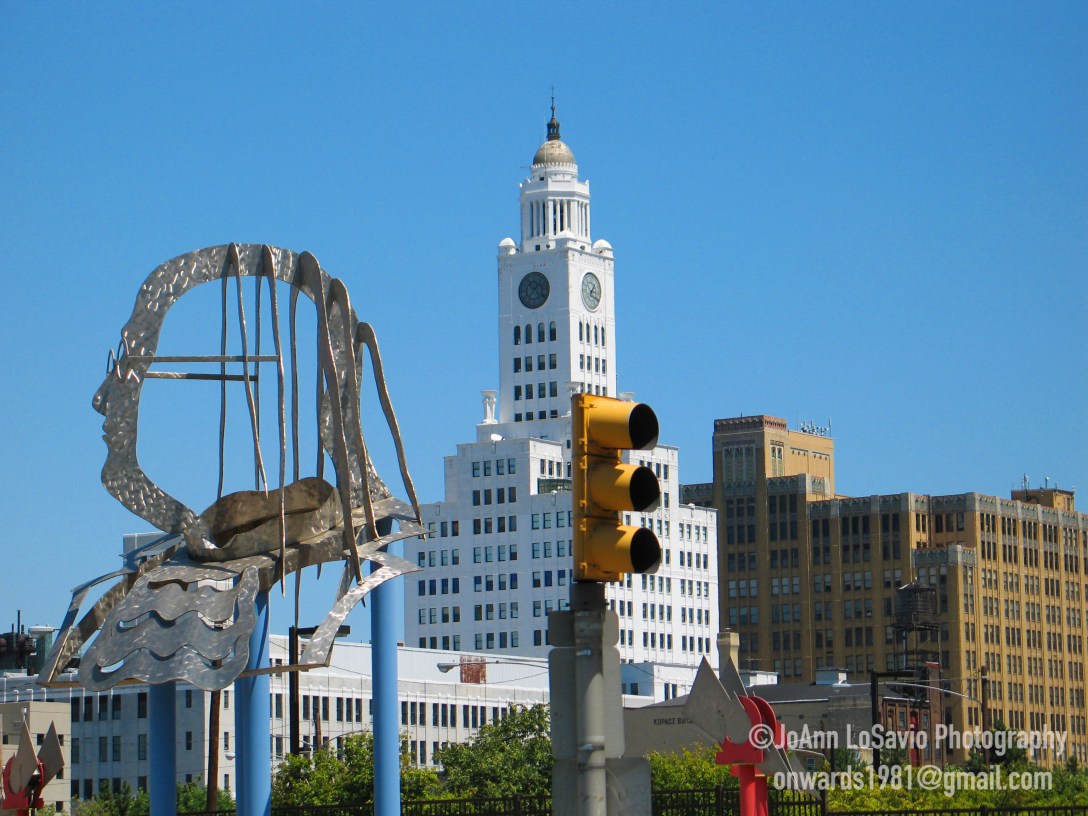
The Philadelphia skyline from a disadvantaged angle.
The composition of this photo appeals to me: its got elements of the city’s artistic character, its functional side, its architectural beauty. For me, everything comes together in this photo, compositionally.
I loved the bridges. There were so many it seemed like, and with the summer sun glinting off the water they looked magnificent.
Most people – including myself usually – don’t like the chunky oblongness of skyscrapers from the 70s and 80s. But I think they work well here; they look almost like building blocks, a child’s toys in a great modern game of Urban City Development. The square windows within square frames, within squat, square buildings. They’re modern but they hint that there’s a post-modern future waiting to bust out of the meta-aesthetic holding them together.
Alfreth’s Alley is listed as the oldest residential (and still residential) street in America. Of course, definitions are flexible; what is a “street”? Must it be paved? Anyway, it was lovely to take a walk down this lane and know that there are still folks living in these houses, caring for them as part of American Living History.
These are heritage houses so they can’t be messed with architecturally or structurally, except I suppose for safety.
I love bus tours! I think they are one of the best and easiest ways to get a first look at a city. I use it as a way to jot down places I want to explore in more depth on my own later.
Around the time I went to Philadelphia there was a lot of hubbub over immigration reform and this notion of “speaking English” in America (and no other language). The owner of one of the famous Philly Cheesesteak places, Geno’s Steaks, had issued these stickers and said his store would turn away anyone who didn’t order in English. Check out the news article on this: http://abcnews.go.com/GMA/story?id=2057207 I don’t support Right-Wing immigration policies, having been an immigrant myself, but I wanted to hear their point of view and I wanted a famous cheesesteak sandwich so I went over there and snapped this photo.
Breakfast meats are a thing of mine. I love SPAM (Yes, the Spam Museum is on my bucket list) so I had to try scrapple when it was described to me at a local diner. It was delicious but I know it probably wasn’t good for me. It was a combination of sausage and processed meat, with a crusty fried exterior. What can I say in my defense? I was on vacation!




 Dr JoAnn LoSavio