
Goyhood: A Novel by Reuven Fenton

Goyhood: A Novel by Reuven Fenton

This novel took me by surprise — and in that wonderful way that good books often do. Goyhood opened me up to new perspectives, reminded me of the strangeness of life and its myriad twists.

The novel lies beyond my usual fare. I tend toward historical fiction, historical non-fiction, and rarely take on contemporary fiction. But the opportunity came my way, and I found a perfect balance of history, culture, and contemporary life in this novel.

Goyhood calls into question the ways in which we build our narratives, our identities, and how those stories can cheat us of who we really are and who we want or could be. The story revolves a young man on the edge of his life, one which he has cultivated carefully and meticulously, and an event which forces him to abandon it. This is the story of his angst and (re)discovery of self. It is also the story of siblinghood, the tumult that comes from deeply embedded family secrets.

It is also, like most stories, one about love, the depths of it and the lengths we take to protect those we love and the love we desire to maintain.

This is also a book about jewishness, though I am in no position to review on that point. I can only say that I found the book informative and am delighted to know more about what it means to be Jewish in America.
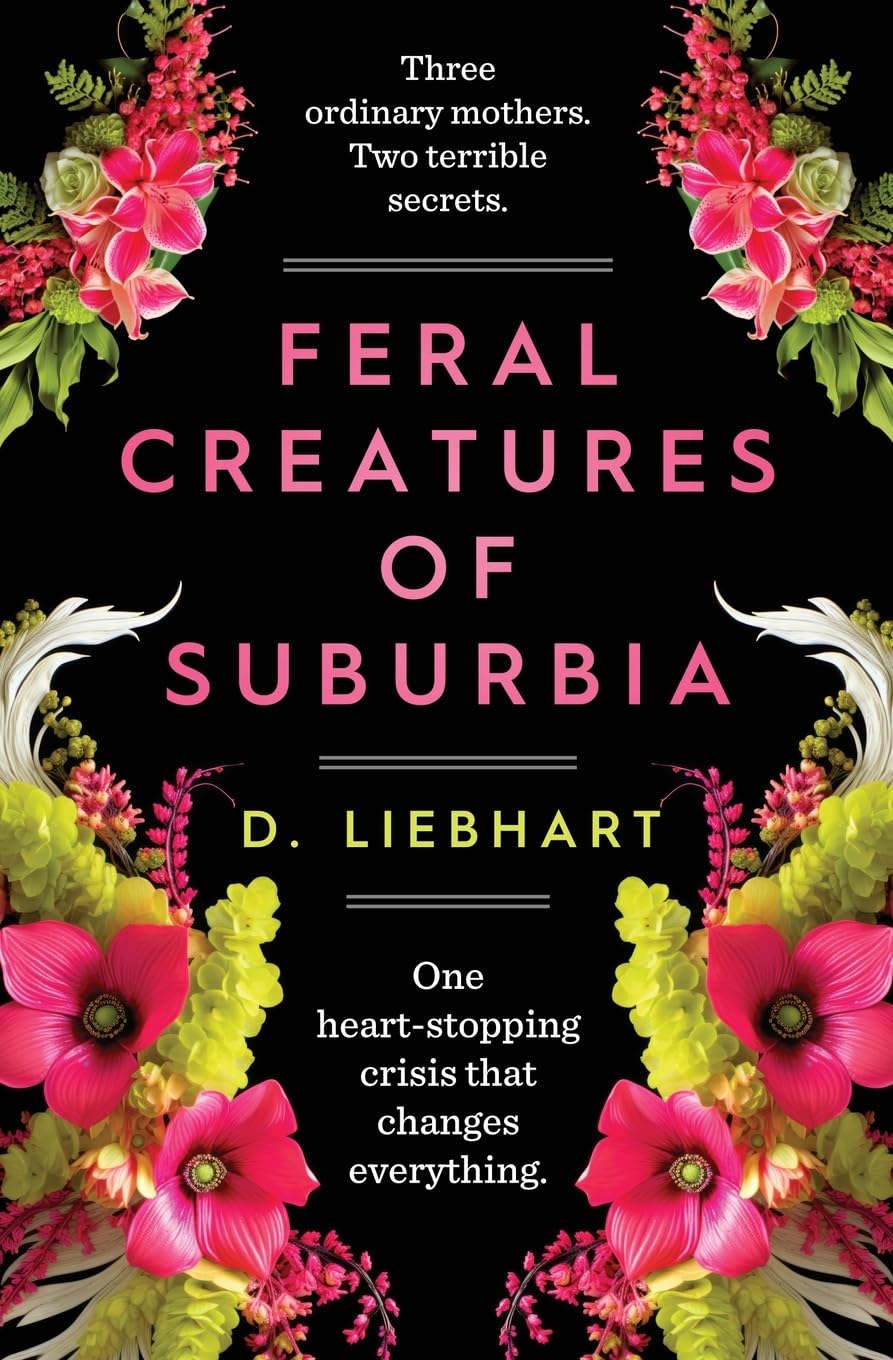
Feral Creatures of Burburbia by D. Liebhart

Feral Creatures of Burburbia by D. Liebhart

This is the second book of D. Liebhart’s I have read and I can’t wait for the next. Contemporary fiction isn’t my usual genre, but Liebhart’s introspective and acutely insightful style borders on literary fiction. This isn’t a casual novel for the lighthearted; Feral Creatures will rip a hole in your soul and leave a scar. But it will be one you treasure as a reader, one that will change your perspective on life and the world — and perhaps how you read. It did for me.

This is, in large part, due to Liebhart’s skill as a writer. The prose is simultaneously lyrical and straightforward, soothing and incisively sharp. There were several moments I had to pause reading, just to take a breath. But the urge to know what happens, the need for resolution drove me back.

The story moves slowly, but the pace is measured and deliberate — and warranted. The story unfolds in overlapping parts, revolving around three women: Julie, Crystal, and Varvara, and their children: Logan, Mateo, and Myra. Their lives are ordinary — recognizable as our own. It is the tragic intersection of their relationships with one another that the novel builds toward. It is a situation we have all — at one point or another — dreaded to prepare for.

Grief, loss, and the hardship of loving their children are the major themes of these women’s’ lives — indeed, of ALL our lives.

Tokyo Ueno Station: A Novel by Yu Miri

Tokyo Ueno Station: A Novel by Yu Miri

This was such a moving story: poignant, profound, thoughtful, soul-wrenching. I can’t help but wonder how many of us live lives like this: short and sad and broken.

The story is an odd one. A ghost thinks back on his life, how the pieces of his life fractured. Decisions were made, as they always are, with the best intentions and the results aren’t always what we hope for.

I don’t want to give it away. You’ll just have to read it. And it’s a short read; there’s so much emotion packed into this small space. There is something performative, a sombre mimicry, about the way this story is condensed — almost truncated — much like the life it is about. The novel feels like a life lived unfinished, in staggered surges.

Like most Japanese novels, Miri’s prose is succinct; the words are few but thoughtfully placed to elicit the most emotional response.

Midnight at Malabar House: A Novel by Vaseem Khan

The Malabar House Series #1

Midnight at Malabar House: A Novel by Vaseem Khan

This novel was so fun to read, and with every one of the detective’s victories I felt like yelling out, “Go get it, girl!”

The novel revolves a young woman who has become India’s first police detective. The case of a lifetime is thrust — seemingly serendipitously — into her lap. But it’s a double-edged sword: she could either emerge from the fight triumphant, the murderer under her arrest, or lop her own head off and prematurely end her career before it even begins. But that isn’t the own tightrope she has to balance.

Malabar House is the name of her station, and its where — as a woman in a male-dominated career –she has to prove to herself, she is a worthy policewoman and Indian citizen and earn the obedience of her colleagues, if not their respect too. Obstacles of all sorts are thrown at her, some from within the ranks and others by those she thought would support her to the most. Betrayal lurks in wait for her everywhere.

It’s a very intriguing story, not only for the mystery at the root of the novel, but because it takes place at a critical moment in Indian history, just as the new nation is emerging from its colonial cage, when change is possible in all sorts of ways (for the better and for the worse), when Britain’s imperial secrets might be exposed under the lights of new India.

I enjoyed both threads of the story immensely. Unlike many postcolonial novels, which are dark and brooding and deeply serious Midnight at Malabar House was joyous and in parts, comedic (perhaps only in comparison). I felt vindicated each time our detective “won one” over her misogynistic colleagues or the corrupt officials who threatened to stand in her way. That said, readers should not expect to be only entertained; the traumatic history of India’s partition, the genocide of Muslims and Hindus, and other dark elements of British imperialism feature here. Post colonial literature is often tinged with some amount of sadness and trauma, justifiably, and this novel has its share of this.

I am not one for book series — I prefer standalone novels and duologies are my usual limit — but I wouldn’t mind reading another one in the Malabar House series at all.

Afterlives: A Novel by Abdulrazak Gurnah

Afterlives: A Novel by Abdulrazak Gurnah

So, I’m a little late to the After Lives party. I usually am to these things. But this book merits uninterrupted attention. It is — like so many of Gurnah’s novels — utterly amazing, and so deserving of the accolades it has received. After Lives is one of those novels that gets into your marrow, a book that I think everyone should read once (at least).

For me, the novel also allowed me a glimpse into East African lives: the complexity of religion and gendered ideas of what is right and wrong, the ways in which women and men view themselves and their role in their communities in this moment in time. I love African literature set in this time period. Readers of Chinua Achebe, Ngũgĩ Wa Thiong’O, and Buchi Emecheta are going to love any of Gurnah’s work. It is a continuation of that lineage.

The novel spans a lifetime, marks the transition of one generation to another, a momentous (and dark) epoch in our global history. The novel revolves around German imperialism in East Africa in the late 19th and early 20th century, but it is not about the colonizers: it is about those who were colonized, those who survived it, lived it, lived through it. European colonization is the background noise — noisy as it is — but the lives of those who lived it is what shines through. In this sense, After Lives is the novel that epitomizes Postcolonial literature: it is empowering, even as it acknowledges and confronts the trauma of European imperialism. It relegates imperialism to the sidelines of the story, even as it is clear those events created the stage on which the story plays out in the first place.

Gurnah is brilliant in their delivery of this reversal of focus.

The story revolves around a young woman whose life is torn apart and rebuilt as a result of German and British imperialism in the region; but she — and those whose lives touch hers — are not merely pawns in the Scramble for Africa. Religion, tradition, love, marriage, gendered expectations and desires, and family are stronger factors which shape her experience of this moment under those global geopolitical pressures. The reader is drawn into her life as she — and her family and friends and community — must navigate these intersecting and interlocking influences to find happiness and a path for themselves.

Fire Exit: A Novel by Morgan Talty

Fire Exit: A Novel by Morgan Talty

Fire Exit is a punch in the heart, the kind of novel that really does leave you heart-sore for a long time afterward.

The novel revolves around and is narrated through a man who is white and, in adulthood, was removed from his residency on an Indian reservation. His eviction and his whiteness separates him from his daughter, and from the life and culture he grew up with on the reservation. Fire Exit is the story of this man grappling with his identity as an outsider, and a story of those on the inside — Indians — who are themselves still in the process of sorting through the legacy of settler colonialism and the co-called Civilizing Mission against them. Fire Exit highlights the fluidity of identity, but also the rigid barriers which define it within ourselves and by others imposed on us. The novel exposes the messiness of relationships, especially in indigenous communities which have been so ravaged by racism and colonial ideologies.

I am reminded again how singular it is that indigenous people of North America are some of the few peoples on earth who must continually prove who they are. I recently read a piece in the New Yorker on Pretendians (typically white people who claim indigenous heritage or identity) and am struck by both the necessity of proof and how exhausting it must be as a human being. It saddens and inspires simultaneously.

The ever-present trauma of colonialism is a burden we cannot put down, any of us; and the pursuit of decolonization can never end. For that reason I am loving this wave of indigenous literature; though not “new,” it feels like indigenous writers and stories are getting more mainstream attention, reaching new audiences (like myself) who find solace and inspiration in them.

But, back to Fire Exit.

Though I cannot know what this is for indigenous people, I can say that as this is also a story about family, what it is to be a family, what is it to act out and perform family, I felt connected to a kind of universal understanding of “family” in my reading of it.

Talty is such a fantastic writer. The words just come together, like lyrics that feel familiar and yet woven together, produce a song I haven’t heard before. The mothers and fathers, daughters and sons in this novel are people we can connect with, and yet, as those living in reservations or on the edges of them, they have a unique life experience, one that I do not know (cannot know, really). I feel that Talty has made it possible for me to feel a little bit of their experience.

It is a sad novel, and a beautiful one.

One Night Two Souls Went Walking: A Novel by Ellen Cooney

One Night Two Souls Went Walking: A Novel by Ellen Cooney

This was such a beautiful, poignant story, the kind of novel that makes you wonder how permeable the line between each of us really is — or if there is even a line.

The story revolves around a nurse and her encounters with patients, coworkers — and possibly a few specters who linger in the halls of this hospital. Time and space aren’t boundaries in this story, not in the typical way narratives run. There are moments when this reader wasn’t entirely sure of what or who was real, but the thing was: it didn’t matter — and I think that was the point.

It’s hard to put this novel into a category, perhaps I shouldn’t, but readers who enjoy literary fiction, pondering life experiences, and paranormal encounters are likely to find it enjoyable.

Cooney’s style and prose was, as with her other novels. impeccably paced, succinctly evocative, perfect. There’s nothing else to say on that point, really. I cannot get enough of Cooney and have several other of her novels on my TBR.

A History of Hangings: A Novel by A. M. Rau

A History of Hangings: A Novel
by A. M. Rau

A History of Hangings is an indigenous horror thriller. It is the kind of novel that hooks you in from the start. It’s creepy and mysterious, but what really delivers the chills is its depth of history, so ever-present in the novel even though it is never fully explained. It is, in a sense, that shrouded, veiled element of indigenous history, emphasized by the erasure of indigenous rights and history that is so compelling, so horrific; I think that underlying premise makes the book palpably terrifying.

Indeed, the novel and its horror can’t be understood without an acknowledgement of what has happened to indigenous communities in North America. As a reader and historian I greatly appreciate Rau’s attention to indigenous experiences, and the way in which Rau weaves in those awful legacies of settler colonialism.

The novel runs on two timelines: Toby, Faye, and Braxton in one thread of time, Edna Bland in the other, bound together by the captives of the Kesseene people of Oklahoma (a fictitious indigenous tribal community and tribe) in a small, rural Oklahoma town that has disintegrated into poverty and isolation. The Kesseene People’s vengeance has become embodied in something — or someone — and this is the terror Toby, Faye, Braxton, and Edna encounter. I’ll leave it at that; the novel is well-worth the read to discover what happens to them and to the Kesseene people. I finished A History of Hangings in less than a day; I had to know what was going on, who was creeping around, why Toby and Faye were so unwelcome — and what would happen to them.

Rau’s story, compelling as it is, is also very well-crafted and this is a major attraction of the book. Rau’s prose is descriptive, and evocative, with a few well-chosen words; Toby, Faye, Edna, Gil, Tim Jim, and the Sheriff — and even the minor characters they encounter — are fully tangible to the reader. The mood is perfectly captured and sustained throughout the book. Rau’s pace is swift too, delivering the reader to the end where all is explained; it is a satisfying and perplexing ending, perfect for a novel of this genre.

Land of Milk and Honey: A Novel by C Pam Zhang

Land of Milk and Honey: A Novel
by C Pam Zhang

Land of Milk and Honey is a haunting novel, the kind that consumes you long after you think you’re done with it. Certainly, it reverses the usual process: where a reader typically consumes, by the end, I felt consumed.

That said, for this reader, my initial attempt to read it caused a slow and uncomfortable indigestion, and I was tempted to abandon the book several times. I found Zhang’s prose felt overwritten, pretentious, too academically literary as if it had been pummeled, shaped, and reshaped in an MFA workshop where Zhang had been too eager to please an implacable professor. The food too, its descriptions and imagery, was overly reminiscent of the kind of unsatisfying fare one might find at Alinea or on Top Chef Season 2,349,349, pretty without satiety. But, in retrospect, having reached the end of the novel: that was the point.

I am glad I did not DNF the novel, and followed it through to the last “course.” It was well worth the patience.

Land of Milk and Honey is a speculative, near-future earth-bound science fiction. Written during the 2020-2023 Covid pandemic when the world had shut down and shut in, Zhang built an insular microcosm of our contemporary world. It is the same, yet different: more intensely bleak, more virulently violent, more callous. Readers, myself included, will easily recognize our pandemic selves in the characters of the novel.

The events of the novel take place in a bleak “what if” landscape, a world which is ravaged by climate change and late-stage capitalism, having never progressed further in its decolonization than our present. Food as we know it is scarce, GMO crops abound out of necessity. Nationalist and populist fears of scarcity have made political borders impermeable, except where power and money create porosity. A young Asian American professional cook trapped in immigrant, stateless limbo in Europe finds herself posing as a chef and working for a strange and shady corporation, one whose mission is evolutionary revolution. This is eugenics gone awry (as it historically has, no surprise here).

Street Corner Dreams: A Novel by Florence Reiss Kraut

Street Corner Dreams: A Novel by Florence Reiss Kraut

Street Corner Dreams is a heart-aching tale about Jewish immigrants in New York City in the first quarter of the twentieth century. Readers who are looking for a tearful, emotional read will find the novel delivers; by its end, readers will find they have lived lifetimes of suffering and joy alongside the characters.

This is a novel perfect for undergraduates and readers new to this genre of immigration literature as it offers an introduction to the lived experience of this period, as well as highlighting the historical context of the age: WWI and the Interwar Years before WWII, American nativism, anti-semitism, and the Prohibition Era of the 1920s. Edifying as it is, Kraut’s approach is literary, making it an easy, entertaining read at the same time. Sweet Corner Dreams fits into the genre of novels I read during my own undergraduate years: Out of This Furnace by Thomas Bell, The Jungle by Upton Sinclair.

The novel begins with Morty, who is born on the voyage over from Europe to America, and the tribulations his aunt and parents face as they navigate the hardships of building a new life in the United States for him and themselves. Morty represents the clash of generations and cultures; as he matures he finds himself torn between tradition and survival, caught up in the criminal and deadly world of NYC in the days of Prohibition. This is also a world of multiethnic plurality: denizens of differing — sometimes conflicting — religions and worldviews must find a way to coexist, recognize their shared humanity. celebrate their diversity.

The story is immediately captivating, and readers will find their interest sustained by the depth of Kraut’s characters. These are people we would recognize today among our own friends and families.