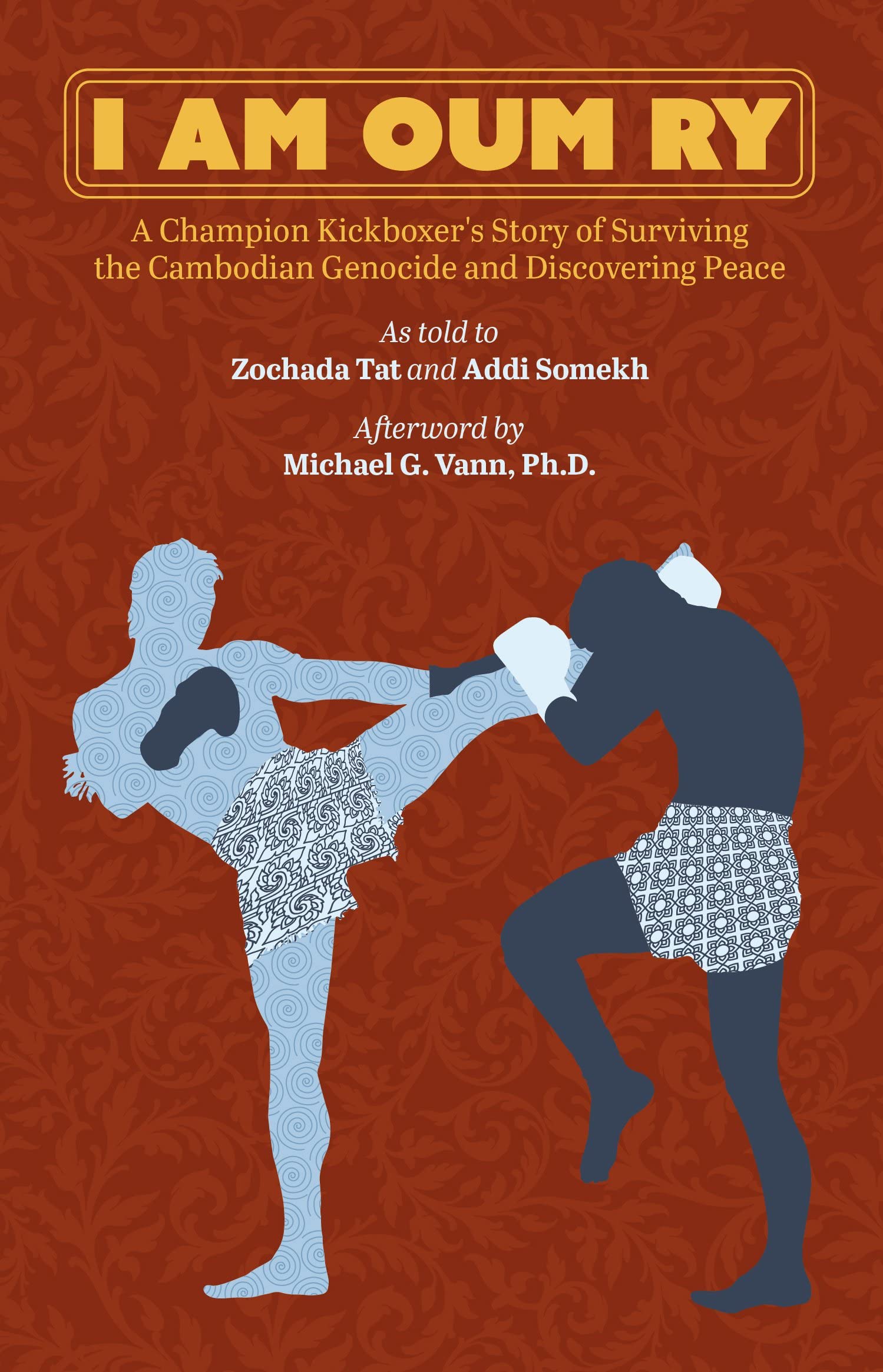
I Am Oum Ry: A Champion Kickboxer’s Story of Surviving the Cambodian Genocide and Discovering Peace by Oum Ry
This memoir strikes hard on multiple levels. It is a reflection of contemporary America and the transnational, transcultural, immigrant experience that many Americans live, whether themselves or vicariously (as Zochada Tat did), as the children of immigrants. Migration is a traumatic event, (sometimes positive, sometimes not, but always) one that reaches across several generations. Oum Ry’s memoir toggles forward and back in time, threading a connection in time between father (Oum Ry) and daughter (Zochada Tat). From this perspective, I Am Oum Ry is an emotional read, a subjective vacuum in which the characters are the primary focus, separate from the context of their world in a way. Tat and Somekh portray Oum Ry, his many lovers, his wife, his children, and the myriad of people who came, left, or stayed in his orbit, in all their flawed perfection; the logics behind his and their behavior as consequences of individualized trauma: parental abandonment, grief of loved ones lost or killed, sexual desire and exploitation.
But people do not exist in vacuum. The individuals in these pages are not ahistorical; they are deeply embedded in histories of patriarchy, Colonialism, the Cold War, the Khmer Rouge genocide, the American/Vietnam War, Cambodian traditions, and collective desires for modernity, belonging, and security.
The memoir takes the reader to Cambodia in the mid-twentieth century, beginning just after WWII. The French stubbornly cling to Indochina. Then ahead to the American War in Vietnam a decade later. It lingers on the five golden years of the 20th century when Cambodia perched on the edge of modernity, part of a larger Southeast Asian moment of revivalism and decolonization and prosperity in the early 1970s. After that the reader follows Oum Ry into the dark age of the Khmer Rouge genocide, and the suffering that followed as Oum Ry, like so many thousands of other Cambodians fled to Thailand to seek asylum elsewhere, anywhere. Oum Ry, like many other fortunate refugees makes his way to the United States where he finds both happiness and deep disappointment. The life of a migrant is bittersweet, filled with hope and longing.
The histories I Am Oum Ry excavates are powerful, a fisted punch to the gut. Oum Ry holds nothing back. The currents of forced migration, war, genocide, and racism that underpin Oum Ry’s words and experiences will knock the wind out of readers. This is an important memoir, not because it is unique — it isn’t, there are many Cambodian-American/Cambodian memoirs written by survivors of the Khmer Rouge — but because it neither indicts or glorifies the past or the present. The Khmer Rouge are not the sole villains of the genocide, though they are largely responsible for the horrors Oum Ry and other Cambodians experience; the Vietnamese and ordinary, fellow Cambodians are part of the horrific milieu of that moment too. America is not hailed as the land of milk and honey; it too is a dark land of racism, crime, poverty, and disappointment. But it isn’t all bad either; Oum Ry and his family find a place in California and become new Americans.
It is also significant in that it highlights pradal serey/muay thai, and centers around this sport. It is unique in this aspect. Oum Ry occupies a unique cultural position as a fighter, a sports icon in Cambodian history and 20th century Cambodian culture; his memoir gives us a rare glimpse into a world of sport and celebrity that was exclusive before the war and certainly much more so afterwards as a result of the loss of so many Cambodian stars.
For me, as a Southeast Asian scholar and a historian of Southeast Asian sport, I Am Oum Ry possesses academic significance. Sport is an often overlooked aspect of history and culture, seen as purely recreational. I Am Oum Ry proves how wrong this assumption is; pradal serey deserves attention as a historical artifact of a lost moment and in the present as a vital element of Cambodian-American identity and Cambodian cultural revival.
For almost every reader, I Am Oum Ry will evoke a multitude of emotions ranging from sad to inspired. Oum Ry’s life has been a rollercoaster in and out of the fighter’s ring. It has been dramatic in positive and negative ways. His is a life worth the reading.
A student recently asked me in class, “Why are there reprints of books? Why do they get reprinted?” Among the reasons I gave them was this one: “Sometimes new information emerges and something important needs to be added. Or, sometimes, the content of the book becomes relevant again, given certain events or things that are happening right now.” I added, “Remember, history is less about the past, than it is a reflection of our present moment or our desire for what we want our future to look like.”
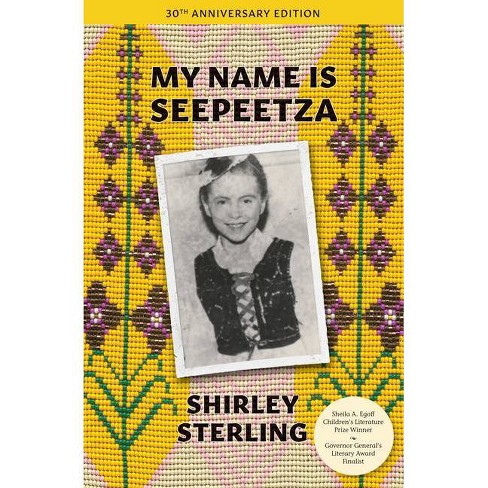
Sterling’s My Name is Seepeetza, the 30th anniversary edition epitomizes this reason. The recent discovery of several hundred bodies of indigenous children buried and hidden at several residential schools across Canada — Fort Pelly, St Phillip, St John, just to name three — is a heavy reminder that the state sanctioned annihilation of Canada’s indigenous culture and peoples over the past four centuries is not a remnant of the past, but a living monster that still lives and looms over the lives of the 150,000 children and their countless descendants.
This is a living trauma, its horror and long reach remain unknown.
For this reason alone, I am considering using this book in my next iteration of a 100-level history course I teach to undergraduates for this reason.
Sterling’s accessible, authentic prose in the voice of a young girl only gives me more reason to assign it as a course reading. The length is perfect for a semester and the format in epistolary style as a diary allows me to use this in class, for small group work within the time constraints of a class session or for short individual activities.
The content though is the main appeal here. Sterling’s own experiences makes My Name is Seepeetza all the more powerful, opens an avenue for an educator to discuss this in more depth as a primary source, as a part of historical record, opens the door for historical discussions and framing it within a larger landscape of indigenous history, gendered and racial violence. My Name is Seepeetza hits on the major nerves: language weaponized, education as violence, eugenics, parenting as cultural intervention, skin color and its tormented relationship with race and ethnic autochthony. History.
A reprint is not merely a revival, it is a reflection and delivery of knowledge we need right now.
I chose Travels With My Grief because I have yet to encounter grief in this capacity. People read memoirs for so many varied reasons. Indeed, I imagine that each of us reads for a variety of reasons. I read memoirs to immerse in a perspective that is not my own, to understand — if only briefly, incompletely, and inadequately — what an experience of life might be. I am a humanist.
Memoirs, therefore, inherently take me to places of great discomfort, places of dark unfamiliarity. My objective is dissonance, the book and my reading of it, a form of liminal initiation by proxy.
Travels With My Grief threw me into an ice-cold alien landscape, one which was terrifying because of its banality: This is an ordinary grief, the loss of a spouse, a friend, a companion, a lover. The wall between my comfortable life and Bloch’s grief-stricken one was a thin one, translucent enough for me to see myself in her stead. One day — my odds are 3 to 1, based on my own fallible knowledge of male and female longevity — I will be in that place, in her place. A widow.
And what then? The journey of grief Bloch takes the reader on is both ethereal, surreal, unreal and all to plausible simultaneously, because no one imagines the death of one so close to themselves and yet, we all must experience it in some fashion — or at very least, contemplate the possibility.
For those same reasons, Travels With My Grief was comforting. Bloch survived, survives, so too will I, could I, must I.
But Travels With My Grief does not convey a simple message of “You Will Survive”, it is more. It is surviving without forgetting, without discarding the grief. Grief becomes a passenger in the life thereafter, where, in the beginning, it might have once been the driving force. Another comforting message.
This memoir is also about the concept of grief, the power — emancipating and debilitating — of the idea of widowhood. There are cross-cultural clashes, competing notions of what it means to grieve, how to do it, what it can or should be in a person’s life. This memoir is about how to live with those shifts in one’s identity, not only internally from our own subjective experience, but also how those who grieve might be treated by others. What does it mean to be labelled, “widow”? How does one live with such an identifier when one hasn’t been that before?
I am glad to have read this. But Travels With My Grief is a memoir that cannot make sense fully to me, not until I am in the throes of this kind of grief. I imagine that when that moment comes, passages from the book may return to my mind or I will be inclined to reread it.
Mennonites? In Uzbekistan? The premise of this book caught me instantly, and I was rewarded for my curiosity. Samatar’s white mosque in The White Mosque is a Mennonite church located in the heart of a Muslim community in Central Asia. Perhaps this reveals a biased tendency on my part; the juxtaposition of the Mennonites in Central Asia suggests an irresistible, exotic historical account.
That — in part — is what Samatar delivers, but the memoir is more than that. The White Mosque is also about the embodiment of a Christian/Muslim, Foreign/Autochthon juxtaposition within Samatar via their experience of living as a Somali-German American Mennonite, a second-generation immigrant in a largely White American community. In one sense, Samatar is a “white mosque” in her academic and personal worlds, as unique and unusual as a pilgrimage of German-speaking Mennonites trekking into Uzbekistan.
The White Mosque begins and ends with Samatar’s touristic, scholarly pilgrimage to Uzbekistan in search of these European Mennonites who traversed that path over a century ago. It is a guided tour. Mennonites, non-Mennonites, tourists, and heritage-seekers accompany Samatar; their observations contribute to this memoir and help shape Samatar’s embodied experience of being a Mennonite of color. The White Mosque also treks back in time, not only through this unique tangent of 19th century Mennonite history, but into Samatar’s past as a child of a Somali father and a German-American mother and as a graduate student. The memoir flickers to the present too: Samatar as an accomplished researcher in pursuit of scholarship.
Indeed, what The White Mosque delivers to the reader is less a historical account, and more a commentary on the present moment, a moment in which cultural-ethnic-religious-racial juxtapositions are worth examination because of the violent divisions in our world along those same lines. This memoir suggests that a closer, more nuanced examination of such transcultural connections, persons, histories, and experiences is worthwhile because they are not as anomalous as they might initially seem.
Midway through reading it, The White Mosque forced me to reconsider why I was attracted to the premise of this book: Were the Mennonites so unusual in their pilgrimage? Is the idea of a European Christian sect in Central Asia such an exotic thing? Haven’t such transcultural phenomenaoccurred all throughout history? …. Mmm. Well-played, well-played. As a historian, a humanist, and an anthropologist, I know that no human phenomenon should be surprising; we have been criss-crossing, mixing, transgressive and transcultured throughout our history. But The White Mosque makes that point poignant, brings it to the forefront cleverly and gently through personal memory, subjective experience, and beautiful prose.
For that reason alone The White Mosque is worth reading.
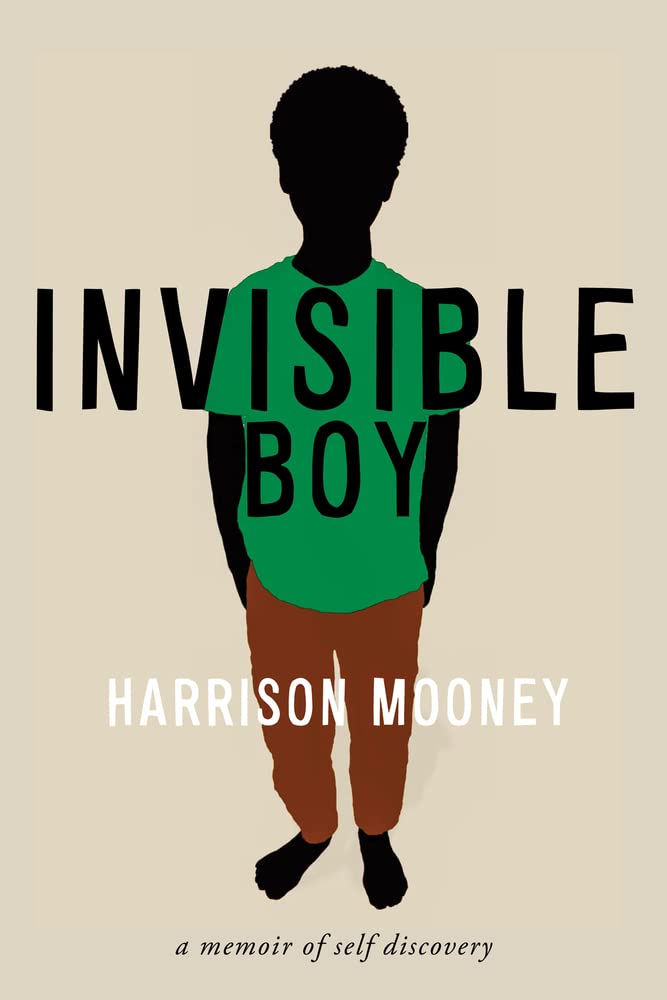
Invisible Boy: A Memoir of Self Discovery by Harrison Mooney
Holy not-so-micro-aggressions. Holy GASLIGHTING. Invisible Boy was incredibly difficult to read without weeping. Every time Harry’s mother or other family members gaslighted him I wanted to scoop him out of the pages of his past and take him far, far away to people who would love him as he is, for who he is, for what he is.
I cry for all the children, teenagers, people who are where he was right now.
For all its pain, I do not regret reading Invisible Boy… because the pain embedded in Harrison Mooney’s past is insidious, latently seething, and all too common still. Decolonization is an eternal task, its end is nowhere in sight. Memoirs and works like Invisible Boy remain relevant and necessary in our collective, societal process towards decolonization. Like Fanon’s Black Skin, White Masks, Mooney’s Invisible Boy is a call to action. It is a reminder that we still need a rebellion of the mind and soul.
Invisible Boy relates the path of Mooney’s awakening to his race and the ways in which racism hides behind a myth of colorlessness. It begins with his childhood and ends in his early adulthood. His memoir exposes to the reader how racism seethes in the most intimate places, in the places it should not exist — in this case, within a family. Families are supposed to be safe. They are supposed to be supportive, loving, nurturing. Invisible Boy tells a sad tale of how racism is the silent reaper within, turning the sanctuary of the family into an emotional, mental prison.
What makes Mooney’s Invisible Boy unique from other works like it (Sam Selvon’s Lonely Londoners, George Lamming’s novels, Franz Fanon’s memoirs and works, James Baldwin’s calls to action, among others) is Mooney’s attention to a community that is little attended to: adoptees of color with white adopted families. As in Mixed-Race Superman, Will Harris’ essay on the transcultural ways of being mixed race, Invisible Boy highlights a different kind of process of decolonization that confronts adoptees of color in white families and white communities that hold onto racist beliefs.
I do not know if I can re-read Invisible Boy for the sake of my own peace as a person of color who has grappled with my own decolonization; but, I am glad I read it at least once and I am privileged to have the ability to choose to only read it once. I am privileged to have been given a rare glimpse into another’s experience of racial awakening. I am privileged that my own decolonization was less traumatic. In truth, Invisible Boy is a book that demands re-reading and reading again. One day I will summon enough courage to read it again.
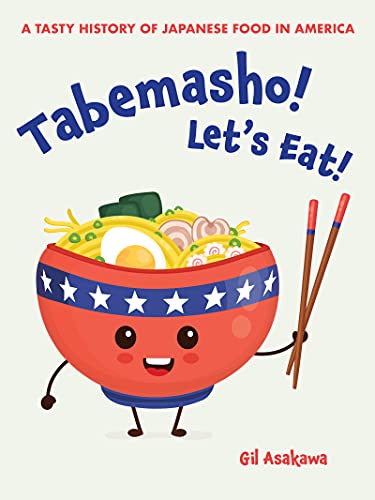
Tabemasho! Let’s Eat! A Tasty History of Japanese Food in America by Gil Asakawa
Tabemasho! Let’s Eat! reminds me of one of the very first times I went out to eat in America. I’d been in the country for a few days, maybe a week, and I was taken out to dinner at a local Chinese American restaurant. I was thrilled, having never had Chinese American food before. At the end of the meal my hosts asked me, “What kind of fortune cookies do y’all have over there?” I was stunned. “We don’t have them in Asia.” Then they were shocked, having always assumed that fortune cookies were authentic desserts from the exotic East. The culture shock on both sides of that encounter and the histories behind the assumptions made around food are what Asakawa’s Tabemasho! Let’s Eat! brings to the forefront.
Though there is a serious side to Asakawa’s Tabemasho! Let’s Eat!, the book is a fun, fun read. Asakawa’s prose is super-casczz, chummy, and hilarious. Reading him is like having a beer with a friend who’s found a great place to eat and can’t wait to take you there. Asakawa was quick at the elbow with a witty comment. He was there to give me the low-down tale behind a (his)story.
I appreciated was the book’s serious side too. I enjoyed how unafraid Asakawa was to speak his mind on the tougher topics of cultural appropriation and America’s racist history of Asian exclusion. Indeed, much of Asakawa’s point is that Japanese American cuisine and culture is borne out of that dark period.
The book is split into thematic chapters, each one taking on a different dish like Noodles or Bowls of Rice (don), or Sushi. Asakawa also devotes a chapter to Japanese American history and the ways in which transcultural cuisine develops through migration, separation, and racism. The sushi and noodle chapters are especially extensive, providing the reader with tips on where to go and what to expect, types of dishes, the differences between Japanese and American interpretations of various dishes, as well as histories of these dishes from both sides of the Pacific Ocean.
There are also chapters on lesser known delectables such as Japanese soft drinks. I was so happy to read about PocariSweat — one of my childhood favorites, sold in Southeast Asia by the case! — which is (I think), the inspiration for one of my favorite fizzy drinks, 100 Plus. I can’t describe how they taste; they’re a cross of salty and sweetness, their appeal much like chocolate-covered pretzels. I grew up in South Korea for a time as well; it was there I became familiar with Yakult, Calpico and the whole plethora of yogurt-based drinks that are so popular in East Asian culture. Reading these chapters was like sipping at a memory of my childhood.
The chapter on baked desserts and pastries made my mouth water. Stopping at a Chinese, Korean, or Japanese bakery is one my favorite weekend excursions. The soft, sweet, white bread that melts in your mouth is a paradise. The red bean pastes, creams, and the custards are unique interpretations of Chinese, French, and European treats.
Asakawa also provides the reader with an extensive (though non-academic) bibliography and reference list so the reader can let themselves wander further on this culinary path.
The Six-Minute Memoir: Fifty-Five Short Essays on Life by Mary Helen Stefaniak
I am probably dating myself here, but do you, Reader, remember that Seinfeld episode when Jerry and George are selling their idea for a sitcom to NBC, and one of them says the show they’re proposing is about Nothing. And the television executives’ jaws kind of drop and they go, “Nothing?”
But the joke — and it’s somewhat dark and certainly very serious — was that it wasn’t really about nothing, it was about all the nothings that make up the something, they anything of life. Oh wait, should that be Life with a capital “L” or life with a lowercase “l”? I’m not sure. Some things in life are Life events, demanding the respect of an uppercase “L” and other things are… the stuff that Stefaniak writes about in The Six-Minute Memoir: Fifty-Five Short Essays on Life. That is, the life stuff (little “l”) are still, despite the derision and the banality of it, the stuff of life.
Stefaniak, in this witty, honest, sometimes painfully raw and sometimes hilarious collection of memory snippets, reminds us to take solace and joy from the mundane, because in the end, it’s all we have in this life. And because of that, by dint of simply being the stuff of life it warrants writing down, it warrants a place in our legacy. Stefaniak’s prose and the stories of her life she’s chosen to share with us, ranging from parenting to grand-parenting, from making friends to losing them, makes that point loud and clear.
The essays are indeed six-minute blurps, taking that long (or sometimes less time) to read and enjoy them. Each one is not necessarily connected to the last, except that they revolve around Stefaniak’s life. They are not chronologically arranged, but thematically so. A reader could drop into any one of these blips on any given day; indeed, this book makes for a lovely New Year’s Day gift, something with a note that says, “Read One A Day for 55 Days, then repeat the ones you loved or made you cry.”
For that same reason, The Six-Minute Memoir is a book a reader could revisit over and over, as the pace of their life changes, as age encroaches with its accompanying set of new revelations and experiences. Stefaniak belongs to a different generation than mine; they’ve experienced grandparenthood, the loss of friends to age and illness, they’ve survived their children’s teenage years. I, on the other hand, am a few events behind, but in Stefaniak’s essays I can see a glimpse into my possible future. The stuff of life is specific to the individual, that’s true, but these events are also common ones across communities, cultures, class, race, and even historical context to a degree. Surely my grandparents and my great-grant parents would relate to the moment they realized their children were no longer children, or the day their own age became more than a known, intellectual fact and more a felt, lived, notched-into-the-bone-marrow sensation.
The Six-Minute Memoir reminds me of the very complicated word, “quotidian.” I’ve always loved this word, because it is such an intricate word for what is meant to be so meaningless. What I’ve come to realize — and this is what Stefaniak’s book is all about — is that the quotidian is as complex as this multi-syllabic word, this word that is spelt with the enigmatic “Q”.
So many of us will never see the alps, will never ride a horse through the hills of Outer Mongolia — but isn’t my life worth a record of its own? Yes, it is!
At the end of the The Six-Minute Memoir Stefaniak provides the reader with a chance to add our own stories to the archive. This is one of the best parts of the book, one of the elements which makes it worth purchasing and hanging onto for future use. Stefaniak gives the reader a selection of Writing Prompts, subtitled, “Write Your Own Six-Minute Memoirs”.
I can think of no better ode to this collection than to follow that directive. So, here goes. My very own 6-minute memoir…
The prompt: “Describe… a photo you wish you had taken — or one that you have lost.”
1997
Melaka is a small city in Malaysia just a couple of hours drive south of the capital, Kuala Lumpur by highway. It sits on the east coast of the country, looking out towards the Indonesian island of Java and over a narrow sliver of calm sea that kingdoms, empires, and nations have desired and fought over for over a thousand years, the Strait(s) of Malacca. The strait was the pathway to China, where traders since the 8th century acquired lacquer, paints, dyes, porcelain, and silk (among other things including weapons, horse saddles, cabinetry, animal skins, you-name-it-they-got-it.) The strait was the entry point to the riches of Southeast Asia too, a place that uniquely produced fragrant spices and herbs like pepper, galangal, ginger, nutmeg, and cinnamon, and woods like sandalwood and teak. For centuries Roman, Greek, African, Islamic and Hindu traders came from all over the world — from North Africa to South Asia — to network with local tribes and chiefs to obtain these goods and access to the larger markets in China. Then in the 14th century, the Portuguese arrived, paving the way for the English, the Dutch, and later the French.
The city that housed the port controlling this coveted bit of sea is Melaka (previously, Malacca). It became the epicenter of these mercantile endeavors and in the 15th century it became the target of these nations jealousies, a symbol and method of economic and political control over the region. Melaka was lost to the Malays who had ruled it for hundreds of years, coming under the governance of various European nations until 1957 when the thirteen Malay states re-asserted its independence. In 1963 the states combined themselves into the nation we know today as Malaysia.
Melaka, with its history, became a UNESCO Heritage site in 2008. But even before then its significance was famous. Jonker Street was (and remains) a huge tourist attraction, for its quaint architecture, its Nyonya restaurants, its hodgepodge of old and new, precolonial, colonial, postcolonial elements, its pop-music blaring rickshaws and tee-shirt/tie-dye sarong shopping, its utter Malaysianness.
I’d always been interested in history. I don’t remember a time when I wasn’t. Melaka was a favorite weekend getaway for me and I often asked my parents to go there. One year I had gotten myself a fancy, SLR camera. It wasn’t a digital one, like the ones you get today. It was a manual Pentax, one of the newer ones made in China. Nonetheless, it was expensive and I had had to save up many, many months of allowances to get it. I bought it in a shop near Bukit Bintang, near where Sungei Wang and the Metrojaya shopping complex used to be. It was one of those shophouses where the aircon was always blowing out into the walkway. I really wanted a fish eye lens and some other fancy stuff, but could only afford the camera and some film. My mother and I went and I spent about $800 ringgit on it. A fortune when you are fifteen years old and have$50 ringgit a month for fun stuff and school lunches. (God, I miss my kanteen food.)
I bought black and white film and color film. My father agreed to drive the three of us down to Melaka for a weekend trip. I saw the excursion as an opportunity for a photoshoot. We wandered around Jonker Street, walked up the hill to the ruins of St Paul’s cathedral, roamed through the ghastly Portuguese, Dutch, and British graves, toured the Stadthuys, the former Dutch administrative building turned into a museum. We ate chicken rice and Melaka Nyonya kuih desserts. I don’t remember much actually.
But I remember my father asking me in an exasperated tone, “Why are you taking pictures of the buildings? Where are the people in your pictures?”
He was right. I avoided taking photos of people in my photographs. I narrowed in on small architectural details like crumbling cornices, focused on the dark green moss growing on a white washed wall, the facade of a shop house.
He said, “It’s the people who are important.”
I disagreed in typical teenage form, through silence and with a surreptitious eye roll. I felt that he did not understand my aesthetic. I was trying to capture a past, an embodied past. Ironically, I saw this past in the concrete objects of buildings and things, but not in people. I did not understand then, as I do now, that history and DNA are entangled, that memory and fact are two sides of the same coin, and that the treasured object (history) is not a static artifact.
I realize now he was right and I was foolish. It took me a few decades after that weekend trip to realize this. Had I taken photographs of people, I might have noticed that
I do not remember those photos I took. I have no idea where they are. It is likely because no one I know is in them.
What matters in my memories are the people who were there. I remember nothing else but the sense of their presence, their smell, their voice, their laughter, their sadness or their anger.
I wish I’d known that and taken pictures of them, my parents and myself with them.
Thank you, Mary Helen Stefaniak for a very profound collection of essays. And for getting me to write my own six-minute memoir.
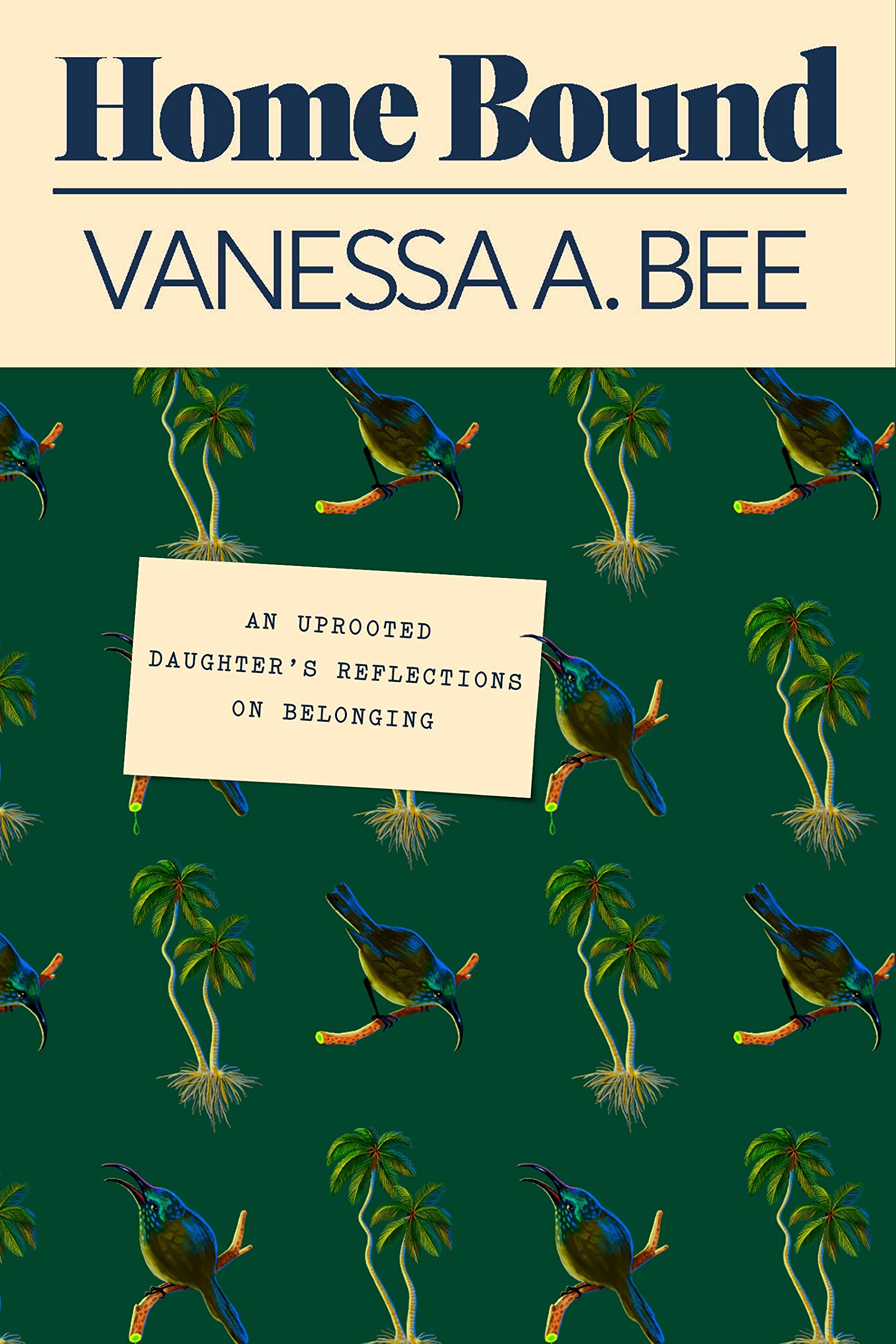
Homebound: An Uprooted Daughter’s Reflections on Belonging by Vanessa A. Bee
It’s been a few days since I finished reading Home Bound and I’m still mulling it over in my head, turning the things Vanessa — can I call her that? Is it too familiar? — has told me. On the one hand, it feels like she and I have much in common: the Spice Girls and Hey, Arnold! are part of the memorabilia of my own 90s teenage years. Vanessa’s memoir strikes a familiar note in many ways. Home Bound is a memoir of movement and migration, transcultural and transnational switching and code switching, and the conflict of culture between places and communities and within a place and a single community. I know that. I’ve experienced that before and now, still.
Home Bound traces Vanessa’s life from her childhood through to the present, across time as well as space. Her life begins in Cameroon, a place she is ever drawn back to (is she as uprooted as the title suggests), but she grows up in France, in a number of places, in a number of homes and neighborhoods. Vanessa disabuses us of any romantic notions of France and how the French live. But then, she makes the point in her memoir that she is only partially French. Her memoir takes us to London where she was more French than English, a mix of Cameroonian and French depending on the location. Then to America, where she becomes domiciled in one of the most American of American states, Texas.
But, of course, Home Bound is more than just a travel log.
The book takes us into deep discussions about gender and what it means to be a woman, what it means to be a sexual being, a sexualized being or object, and how to object to that objectification. It explores mothering and growing up, coming-of-age and what that means when it is done across multiple cultures. The book is also about faith, the religious kind and the internal, subjective kind (“believing in yourself”). Vanessa boldly brings up being of mixed race heritage, discusses adoption and parentage. Lineage is a major thread that winds through the book, guides the reader. Ideas are intergenerational, travel through blood as well as through proximity, from a caregiver to their charge. Education is not merely academic, formal, institutionalized. Home Bound makes it clear that it is more complex than that, it is pervasive within and out of the classroom.
The classroom is a large part of Vanessa’s memoir. I should say, education is a large part of her memoir. The classroom is the locale of her education, the formal kind and the ideological kind. It is here, in the discussion of education and upbringing that Vanessa’s story departs from my own and I feel like I am watching a film of someone else. Someone who feels familiar but is not me.
There is familiarity in the the demise of her American dream. Its death is similar in some ways to what happened to my own. She says in one part how she had thought of herself in some ways as white, having been raised and lived among white people for so long. It’s not an uncommon experience. Fanon was onto something universal when he warned us of masks and disguises that fool no one but ourselves. Vanessa and I both woke up. Then our American dream died, unable to sustain in the reality of 21st century capitalism and American privatization, without a trust fund to help keep it breathing. The classroom had a lot to do with the deaths of our dreams.
I realize now, as I write this, why I call her Vanessa. It seems like Bee isn’t her name. Shouldn’t it is be Billé? And why “A.” and not “Assae”? I suspect this has something to do with the subtitle, Uprooted. For me, the subtitle, AnUprootedDaughter’s Reflections on Belonging, strikes me differently, perhaps because of my academic background in history. The subtitle calls to mind Oscar Handlin’s The Uprooted, that magnum opus of migration history that centered the migrant, their “peasant” origins, and their struggles to find their feet — plant new roots — in American soil. Did Vanessa mean to infer a kind of transition from peasantry into… educated bourgeoisie? I don’t know. I don’t think so. I can’t see it. But uprooted means something. Perhaps it is the violence of being separated from one’s comfortable ideas, coming to terms with the deflation of an illusion; in Vanessa’s case, of her fathers, her faith, her marriage, her trust in men, her color and all that “color” means as it is used to define us in others’ eyes and as we use it to define ourselves.
This is a complex memoir, as complicated as Vanessa’s personal history. It sprawls, but its many parts and tangents cohere to a single theme: Home Bound is about figuring out who your people are and realizing that we will not find a perfect fit in any community. We will belong in some ways, be alienated in others. Some times it is a matter of chronology; we belonged in the past, we cannot belong in the present. Sometimes we belong with strangers, sometimes those closest to us are not those who should have our trust. If I sound bleak, I do not mean to; Home Bound makes it clear that the journey — perhaps for all of us — is complicated — and sometimes it really helps to see how someone else navigated it.
Home Bound is a profound, nuanced memoir well-worth the reading.
The Ghosts That Haunt Me: Memories of a Homicide Detective by Steve Ryan
These memories have haunted Steve Ryan, and now they haunt me too. Ryan warns the reader that the contents of this book will be dark, warns us to close it and move on if we value our peace of mind. He’s right. This book will cleave to my bones like scars from bites. The murderers in Ryan’s cases are depraved animals, creatures looking like humans but lacking humanity. The crimes recounted to us are sweat-inducing-chills-on-the-soles-of-my-feet terrifying. The thing is, they were committed for such trivial, banal, forgivable reasons, sometimes for no reason at all except for the purpose of inflicting pain.
Ryan weaves into his account the effect of these crimes on his psyche, giving us — those who have not worked in policing work or its related domains — insight into the damage being witness can cause. We don’t just see the effect on Ryan, but on the entire community of those who do this work. It becomes quickly clear that this work is as emotional and psychological as it is mired in materiality: these people study the severing of a life from its body, but in this memoir we see how deeply entwined the soul is to the the gory material left behind. In a sense, the homicide detective is required to lend the dead their own soul, a poor but necessary substitute in the effort to ameliorate the injustice of the victim’s murder.
The reader will weep for Ryan and for all homicide detectives as much as they weep for the victims and their families. And, let us also not forget, the families of the murderers — in some cases, the extended family of the murdered and the murderer are one and the same, a double slice, the cut twice as deep.
Ryan takes us through six of his most memorable, most awful cases, the ones which made him value his humanity. They are baffling in different ways: How could this have happened? In some cases the murder was sudden, a crime of impulse and opportunity. In others, it was planned with meticulous attention to detail. Some murders were the inevitable outcomes of years of abuse, the eventual killing a culmination of many crimes perpetrated. The scars were not always only the fatal ones.
These cases occurred in Canada, Ryan being a detective in Toronto and serving the GTA (Greater Toronto Area), but these will be familiar to any urban resident. The cases here involved immigrants, travelers, transnational cultures and expectations, mothers, wives, husbands, lovers, children, fathers, brothers. There is the odd stranger as well, a crime committed via a random encounter by someone the victim does not know — to be fair, the discovery of a murderer in the family can invoke a feeling of utter strangeness and dissonance, it is so unfathomable that someone we hold close and love could be capable of these kinds of crimes — but Ryan proves to us that intimacy is not a prerequisite for really knowing the interior mind of anyone. We can never really know the person we sleep next to at night. That’s the horror here. Trust is malleable in the mind and hands of murderers.
I’m glad to have read this book, chilling as its contents are. I sleep worse for it. But I a little less so because of people like Steve Ryan. I am grateful people willing and able to sacrifice a little of their soul to deliver justice to victims of crimes like these.
We Are Not Okay: Elegy for a Broken America, Memoir-in-essays by Christian Livermore
The title alone is enough to catch anyone’s attention. “We are not okay” are words that resonate across the world, with anyone who’s been alive for the past ten years — or the last three, for that matter. I’m not the first to tell you, Reader, that we are still struggling through a pandemic, an era of shrinking wages and increasing inflation, inadequate housing, dismal health care, sweltering/deluging/freezing climate change, and the list goes on and on and on… And has been accruing for… well, since human society began. And that’s part of Livermore’s point: We have not been okay for awhile and this is an intergenerational problem, an unescapable inheritance that will just keep paying it forward over and over — though, hopefully, with less interest for each successive cohort.
The teetering house on the stark cover of Livermore’s book is home for many of us. If I had a house, it might have been my own. This is We Are Not Okay‘s appeal: it is a book that sends a familiar vibration in all of us (except the wealthy 5%), “us” meaning the lower, working, striving-to-be-middle-class end gamers. I think Livermore (and I) are accurate in our assumption that there are more of us in this category, more of “us” than we want to admit to. It’s taken me decades to shrug off my mother’s middle class aspirations and acknowledge that we’ve balanced on that razor edge for generations, a paycheck, a job, a single recession, a whiff of luck and one good friend away from being not okay.
Here is where Livermore shows their metal: it’s not where we are now, but where we’ve come from that marks us. Poverty is that malingering virus that begets a comorbidity of chronic dysfunctions so banal as to be classified as “life” or “age.” (Health is one of the key points Livermore brings up, health and unhealth those of the lower and lower-working classes just assume to be a part of living.)
I am writing this on my Mac Air, which I bought new (with a justified educator discount) and I have a great job — and like Livermore, I have a degree that I thought made me… well, to be frank, classy. Now, in some ways — and Livermore doesn’t raise this point much — my degree has elevated my status. I can command a kind of respect in some circles, not so much in others. (My brother asked me in my last year of graduate school, “What’re you going to do with that degree? You must really like school, you keep going back.” What he didn’t say was, “For the love of biscuits, WHY?” I replied, “Yeah, I’m not going to make much money, but it’s important to me.” And it is. It really is. But, I digress.)
Livermore’s point is: Poverty is not a number, it is not something you can grow out of or improve, except in that small incremental way, like a credit score — but not really within one’s lifetime, but through generations. Three points up in one generation. Twelve points down the next. Because someone lost a job, had a mental breakdown, fell into alcoholism… Three points up in a month. Twelve points down in this lifetime. Because I paid off my car. Poverty is not something Livermore, I, or anyone can erase with a piece of paper that confers on the bearer the title “Doctor” — and a student loan. But we can learn the appropriate disguises, find the a mask that hides our origins enough. I can pump up my credit score enough to get that car loan, I can.
This is a form of code switching.
But here is where Livermore and I part ways a little. Code switching for me and for many other Americans is embedded in a racial history. Livermore is white, their experiences are also white. This is not to say Livermore is raceless; no one is without race. But there were elements of Livermore’s story I couldn’t fully reconcile. It is here that Livermore schools me (though it’s a lesson I’ve learnt before, it is one worth repeating): White code switching is class-passing. Race and class are inextricably intertwined, it’s true. Racial code switching for whites pulls from the intangible domain of “class.”
Class is a tricky category, meaning so many things, some tangible like income and the size and type of your house, others intangible like the way you hold your fork. I see it in my students (of all colors and races and ethnicities) who don’t ask for help in class or anywhere because they’re used to not getting any, used to being beaten down, used to being denied. Class is about getting access to things and services and attention. Whiteness is about the same, but not all whites have class. And the way in which Livermore presents that is brilliant.
Livermore’s prose is authentic, the highest praise I can imagine for a memoir. It is brutal in parts and funny and sad and emotional. It is detached in other parts. It is cold and harsh. It performs the emotions and conflicts Livermore is bringing to the forefront. This swiveling, this code switching is a key characteristic of poor people. It is self hate, it is selfishness as self care. It is as convoluted as humanity because poverty is a wholly human construction built on the development of hierarchical society, that is: civilization.
Livermore’s We Are Not Okay follows in the vein of Tara Westover’s Educated: A Memoir in that it explores the embodied cultural legacies of poverty. However, Livermore’s book differs from Westover’s in that it is more relatable. First, Westover’s book is grounded in a specific religious community, society, and history. Livermore’s background is more ordinary and bland, therein, more relatable. Livermore might be anyone’s neighbor, anyone’s school mate, anyone’s professor. I wonder now how much or how little do I know about my colleagues, my former professors. Do I see their whiteness and assume a privilege that isn’t really there? Livermore’s We Are Not Okay is one to linger with any reader. I will think of it when the Fall semester begins again, as I look into my sea of students, throw back summer stories with my faculty peers. Second, and perhaps more poignantly, Livermore’s We Are Not Okay does not come to a natural closure as Educated: A Memoir does. I will not spoil the ending; you’ll have to read it. Let’s just say Livermore’s memoir is… realistic. It is not that Westover’s is not, but if you’ve read Educated: A Memoir it does come to an organic closure. Livermore leaves us in that teetering house, pondering our own fate… This is part of the lingering of this book, a sensation that makes this worth reading.
Livermore delivers. This is a book that will stick with you. It may even dig into your bones where poverty may have been leaching away at your marrow for longer than you know.




 Dr JoAnn LoSavio